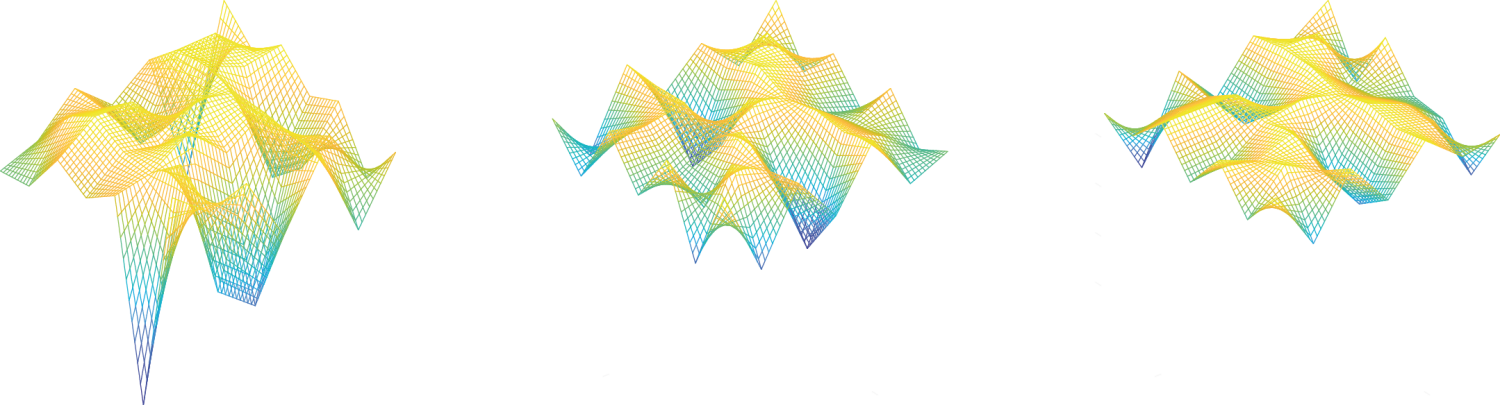
The brain is not a static object, but it changes over multiple time scales. My research focuses on whole-brain functional fluctuations that can be observed in the order of seconds to minutes. These brain dynamics have been shown to be related to behaviour and cognition, as well as neurological and psychiatric disease.
My research mainly focuses on human brain dynamics. I am interested in questions such as: How is brain function organised in time (and space)? Can we find patterns in brain dynamics? And how can we describe these spatiotemporal patterns? To study these questions, I use computational modelling, methods development, and applied machine learning in neuroimaging.
Brain dynamics
If we want to predict if a person will develop a neurological or psychiatric disease, we need to observe how their brain unfolds dynamically. But models of brain dynamics are complex and often have a high number of interrelated parameters, making them difficult to use in a linear predictive model. The Fisher kernel is a mathematically principled and computationally efficient approach to solve this problem. It can predict various demographic and cognitive variables in a large sample from a Hidden Markov model of brain dynamics, in a way that is not only accurate, but, critically, also reliable:
Christine Ahrends & Diego Vidaurre (elife, 2025). Predicting individual traits from models of brain dynamics accurately and reliably using the Fisher kernel. elife.
doi: 10.7554/eLife.95125.3
Code for this preprint is available in the Github repository: https://github.com/ahrends/FisherKernel, in the GLHMM toolbox (Python): https://github.com/vidaurre/glhmm and in the HMM-MAR toolbox (Matlab): https://github.com/OHBA-analysis/HMM-MAR
We have recently put together a practical guide to dynamic functional connectivity methods in fMRI, including various code examples you can use to get an understanding of some of the different approaches and get started with your own analysis. This also includes a section on how we can evaluate and test dynamic functional connectivity models:
Christine Ahrends & Diego Vidaurre (2025). Dynamic functional connectivity. In: Filippi, M. (eds) fMRI Techniques and Protocols. Neuromethods, vol 220. Humana, New York, NY.
doi: 10.1007/978-1-0716-4438-6_11
Code for this chapter is available in the Github repository: https://github.com/ahrends/DynamicFC_examples
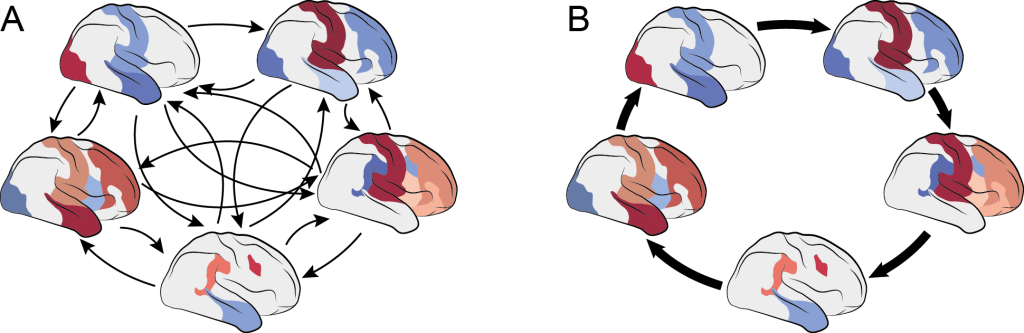
Among the various approaches to modelling brain dynamics, I have used state-based models of brain activity and functional connectivity, such as the Hidden Markov Model, in fMRI recordings. We have studied how aspects of the data and the model can affect the estimation of time-varying functional connectivity in fMRI and come up with practical recommendations based on these results:
Christine Ahrends, Angus Stevner, Usama Pervaiz, Morten L Kringelbach, Peter Vuust, Mark W Woolrich, & Diego Vidaurre (2022). Data and model considerations for estimating time-varying functional connectivity in fMRI. NeuroImage 252, 119026.
doi: 10.1016/j.neuroimage.2022.119026
Code for this paper is available in the Github repository: https://github.com/ahrends/mixing
I am also interested in concepts from the study of dynamical systems to understand these temporal patterns and the relevance of these theories for cognitive, affective, and social neuroscience:
Christine Ahrends, Peter Vuust, & Morten L Kringelbach (2021). Predictive Intelligence for Learning and Optimization. In: Aron K Barbey, Sherif Karama, & Richard J Haier (Eds.). The Cambridge Handbook of Intelligence and Cognitive Neuroscience (pp. 162-188). Cambridge: Cambridge University Press.
doi: 10.1017/9781108635462.012
In my PhD, I have studied the role of uncertainty and predictability in human brain dynamics. I argue that uncertainty in brain dynamics makes the prediction of a future state of the brain difficult, but the degree of uncertainty may be an important principle for explaining the normal waking and altered brain, allowing its flexible dynamic configuration:
Christine Ahrends (2021). Uncertainty and predictability of human brain dynamics at rest, during auditory processing, and under LSD: PhD Dissertation. Health, Aarhus University.
Royal Danish Library: https://soeg.kb.dk/permalink/45KBDK_KGL/1pioq0f/alma99124013143405763
(Contact for full text)
Applications
Mental health
In many neuropsychiatric conditions or states in which mental health is compromised, the configuration of the whole brain can be altered. The patterns in which brain function is organised in time can help understand these conditions. In these collaborations, we have striven to use insight from brain dynamics in the study of mental health and neurodivergence:
Patricia Alves da Mota, Eloise A Stark, Henrique M Fernandes, Christine Ahrends, Joana Cabral, Line Gebauer, Francesca Happé, Peter Vuust, & Morten L Kringelbach (preprint, 2020). Sweet anticipation: Predictability of familiar music in autism. bioRxiv.
doi: 10.1101/2020.08.03.233668
Anaïs Louzolo, Alexander Lebedev, Malin Björnsdotter, Kasim Acar, Christine Ahrends, Morten L Kringelbach, Martin Ingvar, Andreas Olsson, Predrag Petrovic (2022). Resistance to extinction of evaluative fear conditioning in delusion proneness. Schizophrenia Bulletin Open, sgac033.
doi: 10.1093/schizbullopen/sgac033
Decision-making and music
During my PhD and Master’s, I have studied predictive processes in decision-making and mental health in musicians:
Christine Ahrends, Fernando Bravo, Morten L Kringelbach, Peter Vuust, & Martin A Rohrmeier (2019). Pessimistic outcome expectancy does not explain ambiguity aversion in decision-making under uncertainty. Scientific Reports 9, 12177.
doi: 10.1038/s41598-019-48707-y.
Christine Ahrends (2017). Does excessive music practicing have addiction potential? Psychomusicology: Music, Mind & Brain 27(3). 191-202.
doi: 10.1037/pmu0000188. (Contact for full text)
 Christine Ahrends
You must be logged in to post a comment.